
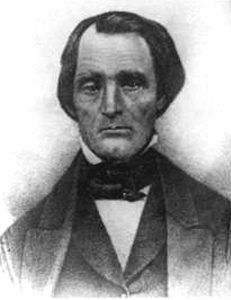
Alexander MacGregor.
Born of royal Scottish descent on May 23, 1804, Alexander MacGregor started life on his parents’ farm in Wilson Junction, New York. He wouldn’t leave the farm until he was 28, and like many others, he sought adventure in the West. In 1832, he landed in Chicago, a small village that had grown around Fort Dearborn.
Here, he would partner with some close friends to form “Land Company No. 1”, which, according to the City of McGregor, bought a large tract of land from the government in the Chicago area and divided it into lots for speculation. Historical records of Chicago or Cook County make no mention of this company or Alexander MacGregor.
Although his business was successful, the urge to push West was too strong, and in 1834 he moved on to what is now Aurora, Illinois, which was newly opened government land. He claimed around 2,400 acres of timberland, improved it, and then quickly sold it in 160-acre tracts. By 1835, he was heading West again, this time to the French settlement of Prairie du Chien, near the confluence of the Wisconsin and Mississippi Rivers. This time, he would become active in the affairs of the growing community and stay.
In 1836, Alexander MacGregor helped prepare a boat for crossing the Mississippi River from Fort Crawford, adjacent to Prairie du Chien, and realized the need for a ferry. With help from business associates Thomas Burnett and James Lockwood, MacGregor bought part of a Spanish claim, calling it first “The Ferry Property.” Europeans first found the area of the Spanish Claim in June 1673, when French Jesuit missionary Father Marquette and trader Louis Joliet explored the region. In 1800, the “Giard Tract” land grant was given to Basil Giard, one of three Spanish land grants in Iowa. By 1837, Giard’s heirs had deeded their shares to businessmen Lockwood and Burnett. Working with Burnett, Alexander purchased additional claim land to protect the ferry from competition.
While MacGregor still lived on the Wisconsin side of the river, the first ferryman, James King, settled on the Iowa side in 1841 and had charge of the first ferry. When King died in 1872, one obituary said of him:
“McGregor’s oldest citizen and first white occupant of the ground on which the city was built… He was a quiet, much-esteemed citizen and a favorite pioneer.”
In 1843, Alexander MacGregor married Ann Gardner. Four years later, the couple moved across the river from Prairie du Chien to the quickly growing settlement, where they had four sons, two of whom died as infants.
That same year, 1847, the settlement was then known as MacGregor’s Landing and became a bustling river community. Ten years later, in 1857, it was officially incorporated as the town of McGregor and quickly grew into a significant commercial center. Also in 1857, the Milwaukee & Mississippi Railroad established a line to Prairie du Chien, connecting Lake Michigan to the mighty river by rail. Other railroads were built from McGregor West, with North McGregor (now Marquette) acting as the rail terminus. When trains reached McGregor from the West, crews took them apart, ferried them across the river, and reassembled them to continue to Lake Michigan.
Alexander MacGregor died in December 1858 at 54, but his wife Ann continued to live in the community until she died in 1890.
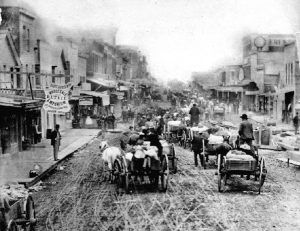
McGregor, Iowa, in 1870.
During the city’s peak, the population exploded to over 5,500. In the 1870s, it was the busiest shipping port in the West, after Chicago. The city boasted 120 businesses, 20 of which shipped grain and goods. Settlers and those passing through on their way to the western frontier could find everything they needed.
Steamboat traffic was also crucial to McGregor’s early life. Between 1871 and 1872, the city shipped over 400,000 bushels of wheat, barley, oats, and corn on the Mississippi River. During that same time, city scales weighed 20,000 hogs, producing five million pounds of pork.
Soon after, improved highway transportation and the railroad slowed the need for steamboats. In 1874, Prairie Du Chien businessman John Lawler commissioned a permanent pontoon bridge to connect the two cities by rail, eliminating the need to disassemble the trains and, in turn, many jobs, and causing the city’s population to decline. That same year, North McGregor was incorporated and later renamed Marquette in 1920.
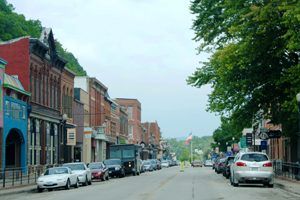
Downtown McGregor, Iowa. Photo by Kathy Alexander.
Three ferries—the Wanamingo, Lorese, and Rob Roy—carried goods and passengers across the Mississippi. Each boat made up to eight trips daily. A suspension bridge replaced those ferries in 1932. The bridge was officially closed and dismantled in the mid-1970s. The Marquette-Joliet Memorial Bridge replaced it in 1974.
Today, McGregor and Marquette have kept their historic charm, but the city has a population of less than a thousand. The nationally registered historic downtown district still contains many buildings constructed during its boom years. As a river town on the Mississippi, McGregor has become a popular tourist destination, known for its nearby Native American “Effigy Mounds,” Pike’s Peak State Park, and the Driftless Area, a region noted for its many deeply carved river valleys. McGregor is an artists’ community worth visiting for its historical value, live local music, and fine dining.
©Dave Alexander/Legends of America, updated September 2026.
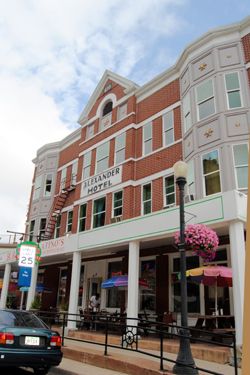
Originally the Lewis Hotel, the Alexander Hotel was built in 1899. Photo by Kathy Alexander.
Also See:
Prairie du Chien, Wisconsin & Fur Trading Mecca
The Mississippi River and the Expansion of America
Sources:
City of McGregor
City of Marquette
McGregor Historical Museum